Water scarcity and increasing consumption across the world have put freshwater systems under unprecedented pressure. Cities, industries, and agricultural regions all struggle with the dual challenge of maintaining stable water quality while reducing total water use. For this reason, advanced filtration technologies-especially those built around the disc filter concept-are in strong demand.
Water savings, high filtration performance, and automation are now key requirements of buyers of filtration solutions in agricultural irrigation, industrial cooling loops, HVAC recirculation, wastewater reuse, and municipal treatment plants. Procurement teams move away from labor-intensive, high-waste systems and toward solutions that ensure operational stability while also reducing water consumption and operational expenses.
This is where disc-based filtration with automated backwash stands out, offering a compelling pathway to achieve measurable water savings-commonly up to 10%-without compromising flow rate or filtration efficiency.
The disc or laminated-disc filter is a thick filtration cartridge formed by stacking together multiple precision-grooved plastic or polymer discs. Water flowing through the grooves captures the suspended solids, silt, and organic particles across a series of layers, thus creating an effect of deep filtration rather than just simple surface sieving.
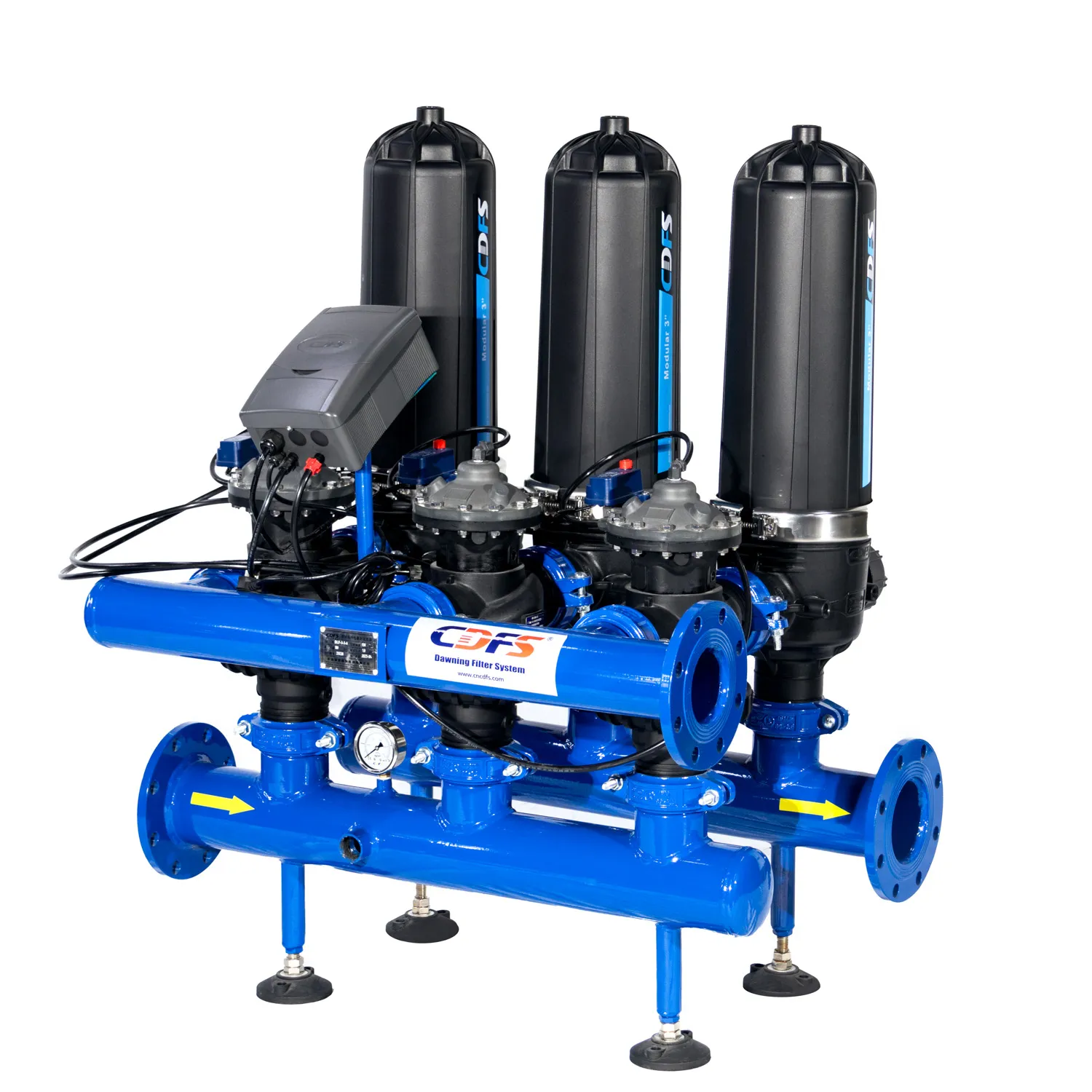
The modern systems, like those from CDFSFilter, incorporate this structure into automated modules and include several sizes to accommodate various applications based on flow and pressure requirements; most notably, there is an automatic disc filter for 3-inch and another for 4-inch sizes.
Major operational benefits include the automatic backwash system. When differential pressure rises or a preset interval is reached, the system automatically reverses the water flow to clean the discs. This translates into no operator intervention, besides ensuring continuity in output and reduction of downtimes.
The disc-based approach offers several significant benefits to professional buyers:
The system avoids unnecessary flushing because the automatic backwash cycle is optimized to run only when needed. This makes the total amount of water required relatively small, given that the reversed and concentrated water flow cleans the discs very effectively. In comparison with traditional sand filtration or manual cleaning systems, the consumption of water in backwash is significantly reduced, thus making a 10% water-saving target realistic and conservative.
The multi-layer filtration structure traps the solids more effectively compared to screens or coarse filters. This ensures consistent removal of:
It is on the basis of such stable water quality that agriculture, industrial cycle water, cooling circuits, and reclaimed water systems depend.
Disc filters have a relatively small footprint, making them suitable for installation in confined spaces or for retrofitting into an existing plant without significant structural modifications. This represents an important logistical advantage for procurement teams handling system upgrades.
Automation eliminates the need for manual cleaning. Operators spend less time supervising the system, and maintenance intervals become more predictable. Fewer interruptions mean longer operating cycles and lower total operating cost.
Solutions can be customized for, with modular units such as the Automatic Disc Filter 3 inch and Automatic Disc Filter 4 inch:
This versatility makes disc systems suitable for both large-scale plants and for smaller decentralized applications.
The "10% water-saving" benchmark is not a marketing claim but a realistic, field-tested figure. Automatic disc-based systems are able to reduce the total water consumption mainly through:
Industry experience has shown that disc systems lead to considerably lower volumes of backwash water than traditional technologies. Continuous recirculation applications for HVAC, industrial cooling water, or reclaimed water pipelines multiply savings over extended periods of several months or even years. This is particularly appealing to buyers focusing on sustainability, cost control, and regulatory compliance.
Disc filters remove sand, algae, and sediment to prevent emitter clogging in drip and sprinkler irrigation systems. Clean water supports stable pressure and improves crop yield, reducing maintenance costs.
Manufacturing plants, power facilities, and industrial cooling loops require stable filtration to prevent fouling, scaling, and unscheduled shutdowns of equipment. Disc filtration provides a reliable pre-treatment step.
The technology protects chillers, cooling towers, and heat exchangers from particulate buildup. Clean water reduces chemical cleaning frequency, along with prolonging equipment life.
Disc filters allow for efficient primary filtration prior to advanced stages of treatment. This reduces the load on downstream equipment, thus lowering energy use and chemical consumption.
CDFSFilter provides disc filter units in multiple sizes, like 2-inch, 3-inch, and 4-inch models, to help buyers exactly match their system flow, pressure, and water quality requirements.
All systems support automatic backwash and can be set up with intelligent control panels-including options for 220V. The modular construction makes it easy to integrate into various international pipeline standards.
Due to optimized water consumption, high filtration precision, and low pressure loss, CDFSFilter systems save on water and energy consumption, resulting in a competitive TCO for long-term operations.
This makes them suitable for agricultural, industrial, municipal, cooling, and reuse applications. Compact dimensions and flexible options for installation reduce procurement and deployment burdens.
Buyers can select the flow capacity, configuration, and expansion options to meet the demands of a project. This is where maximum operational stability and cost efficiency can be attained.
With ever-increasing demands for water scarcity and sustainability, it is required that procurement decisions must balance between efficiency, reliability, and long-term cost control. Disc filtration technology offers measurable water savings, stable performance, and dependable automation—especially in automated systems like the Automatic disc filter series.
CDFSFilter welcomes professional buyers to discuss project needs, request technical documents, or get customized system proposals. With rapid support, global delivery capability, and proven product performance, CDFSFilter provides trustworthy filtration solutions for modern water-saving strategies.
Adaptive backwash cycles further trigger only when required, thus limiting superfluous flushing and generally reducing total water consumption.
The main difference in flow capacity is that the 4-inch model allows for higher flow rates and is therefore applicable to bigger systems.
Yes, it does so with the multilayer disc structure that provides deep filtration and hence may work effectively against challenging water conditions.
Yes, small size and modular structure-these two properties make integration quite easy even in confined areas.
Routine inspections are at a minimum since the system performs automatic backwash without operator interference.



 EN
EN
 FR
FR
 NL
NL
 RU
RU
 AR
AR
 VI
VI
 LO
LO
 RO
RO
 TH
TH
 MY
MY
 MS
MS
 PT
PT
 ES
ES
 KO
KO
 BE
BE
 JA
JA
 FIL
FIL
 KA
KA
 DE
DE
 IT
IT

